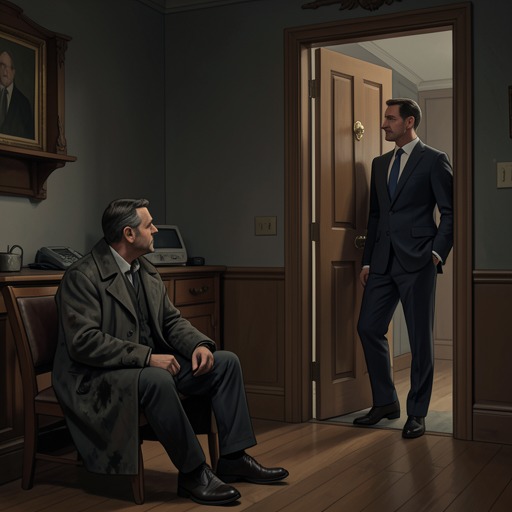
Simonov
Notes from UndergroundSimonov is a former schoolfellow of the Underground Man and the practical organizer of a dinner for Zverkov. Though the evidence gives little direct access to Simonov’s private thoughts, his actions frame a chain of encounters in which the narrator’s eagerness to be included, his concern for his standing among former classmates, and his efforts to repair the aftermath become visible. Simonov serves both as a participant in the gathering and as the recipient of the narrator’s later financial and rhetorical attempts at reconciliation.
Identity and Role
Simonov appears among the Underground Man’s former schoolfellows, in a social circle that includes Zverkov and the other men invited to the dinner. His most clearly established function is organizational: he has been asked to make the arrangements and confirms the plan at the Hotel de Paris. This practical responsibility puts him at the center of the invitation, while leaving the narrator to negotiate whether he belongs among the guests and what his inclusion will cost.
The dinner plan is first stated as twenty-one roubles for the three participants, with Zverkov as the fourth. The Underground Man immediately objects that, if he is counted, the amount will be twenty-eight roubles. Simonov then decides to put his name down and specifies the time and place: five o’clock the next day at the Hotel de Paris. The exchange makes Simonov the person who converts the narrator’s unexpected self-invitation into a confirmed place at the table. It also makes the narrator’s inclusion a matter of both social recognition and money.
The Dinner and Social Standing
The narrator’s relation to Simonov is shaped less by familiar ease than by the narrator’s acute reading of social signals. At the dinner, the narrator’s attention is fixed on how he is received by the assembled former schoolfellows. When Zverkov arrives with the others, laughing and apparently their leading spirit, he approaches the narrator with measured courtesy and shakes his hand in a friendly but restrained manner. Simonov is part of the audience before whom the narrator hopes to recover a sense of importance, even though the evidence does not describe Simonov’s own reaction in detail.
After the gathering, the narrator treats his standing in Simonov’s and Zverkov’s eyes as an urgent problem. He explicitly puts the task of saving his reputation with them ahead of other concerns, and, in his preoccupation with this repair, forgets about Liza for a time. The episode shows how a social encounter extends beyond the dinner itself: the narrator continues to stage and revise it afterward, treating Simonov’s opinion as part of a judgment he must manage.
Borrowing, Apology, and Repayment
The narrator owes Simonov money from the previous day and decides that repayment must be his first practical step. He borrows fifteen roubles from Anton Antonitch, who provides the money on the first request. This borrowing allows the narrator to address his debt to Simonov, but it also underscores the material dependency beneath his concern with appearing respectable: his attempted social repair begins with money he does not already have.
On returning home, the narrator writes to Simonov in a tone he later admires as gentlemanly, good-humoured, candid, tactful, and well-bred. The letter blames the previous evening’s conduct on wine, claiming that he had drunk a glass while waiting at the Hotel de Paris between five and six, before the others arrived. He asks Simonov’s pardon in particular and asks him to convey an explanation to the rest, especially to Zverkov. The apology thus combines an address to Simonov with an effort to influence the wider group’s view of what happened.
The narrator then acknowledges to himself that the excuse is false: he had not drunk anything during the claimed interval and had lied shamelessly to Simonov. His self-congratulation over the letter’s polished tone therefore sits beside his admission that its central explanation is fabricated. He puts six roubles into the sealed letter and asks Apollon to take it to Simonov; when Apollon learns that it contains money, he becomes more respectful and agrees. The money is a concrete gesture of attempted restitution, but the narrator’s account makes clear that it travels alongside, rather than replacing, deception.
Narrative Significance
Simonov’s importance lies in the way his limited actions set the terms for the narrator’s self-exposure. He arranges the dinner and confirms the narrator’s place, then becomes the person from whom the narrator has borrowed and to whom he sends money and an explanation. Around these transactions, the narrator repeatedly tries to control how others interpret him: he insists on being counted in the dinner cost, pursues the company’s recognition, and composes a carefully mannered apology that conceals the truth about his drinking.
The contrast between the letter’s cultivated surface and the narrator’s admitted lie gives Simonov’s particular role a wider narrative force. He is not presented as a confidant who resolves the narrator’s predicament; instead, the correspondence records the narrator’s effort to turn embarrassment into a manageable social performance. Even the partial repayment and formal apology fail to erase the deeper contradiction between the image of candor the narrator constructs and the false account he knowingly sends. Simonov’s place in the episode therefore helps reveal how the narrator’s pursuit of reputation can persist after an encounter has ended, reshaping debt, courtesy, and apology into instruments of self-presentation.